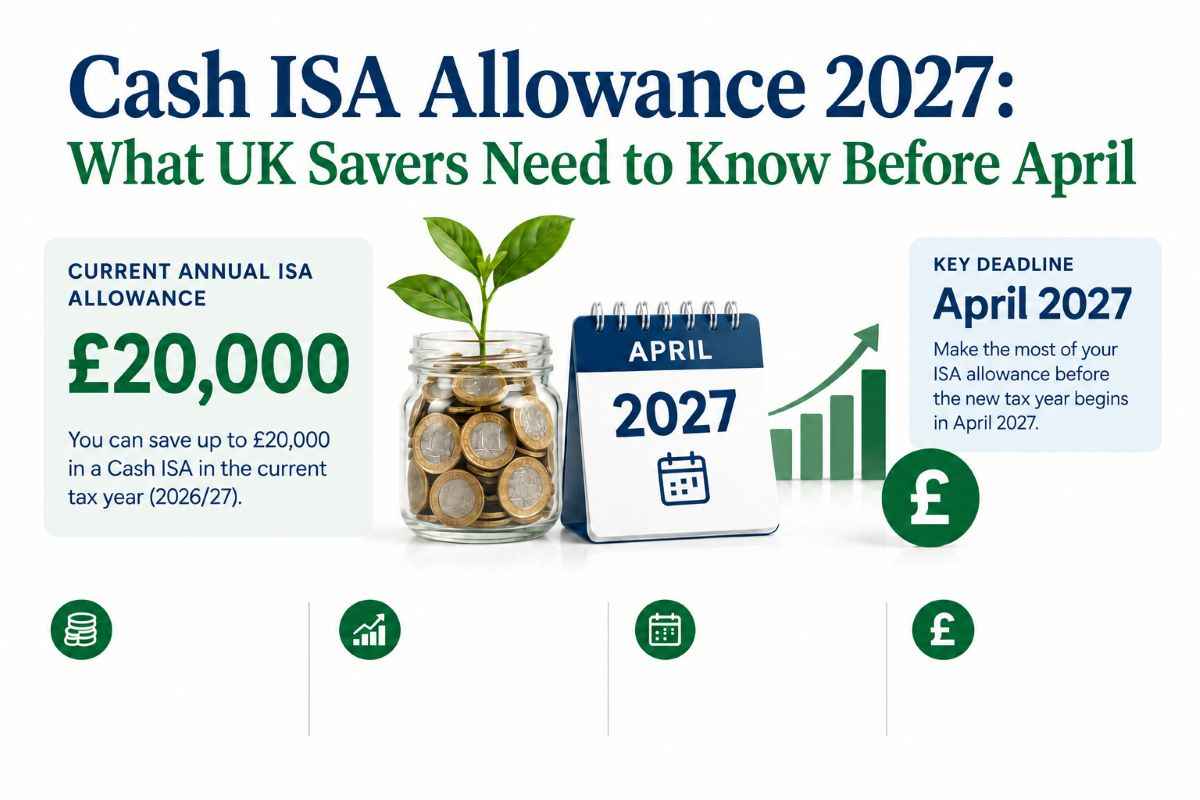
The Cash ISA allowance 2027 will be £12,000 a year for savers under 65, starting on 6 April 2027. For those aged 65 or over under the new rules, the annual Cash ISA limit will remain at £20,000. The overall annual ISA allowance will also stay at £20,000. HMRC confirmed these changes in September 2026.
This change means some savers will need to rethink how they divide their money between cash savings and investments. If you currently put the full £20,000 into a Cash ISA each tax year, understanding the new rules before April 2027 can help you plan your next move.
Here is what the new allowance means, who will be affected and what you can consider doing before the rules take effect.
What Is the Cash ISA Allowance 2027?
From 6 April 2027, the annual Cash ISA subscription limit will be:
- Under 65: £12,000 per tax year.
- Aged 65 or over: £20,000 per tax year.
- Overall ISA allowance: £20,000 per tax year.
These limits apply to new contributions, known as subscriptions, during a tax year. They do not mean you must withdraw money already held in a Cash ISA.
The new limits are set out in the Individual Savings Account (Amendment) (No. 2) Regulations 2026, which come into force on 6 April 2027. Read the legislation on GOV.UK’s legislation website.
The main change affects how much eligible savers under 65 can contribute to cash-based ISAs. The total amount they can contribute across their ISAs remains £20,000.
Why Is the Cash ISA Allowance Changing?
The government says the reform is intended to encourage more people to consider investing, rather than keeping all their tax-advantaged savings in cash.
Cash ISAs allow savers to earn interest without paying Income Tax on that interest. Stocks and Shares ISAs offer a different type of tax advantage: eligible investment income and gains can grow within the ISA without the usual personal tax charges.
However, investments can fall in value, and returns are not guaranteed. Cash savings may be more suitable for emergency funds, short-term goals and people who cannot afford to take investment risk.
The new rules do not remove Cash ISAs. Instead, they limit annual contributions for people under 65 while retaining the higher limit for older savers. The overall ISA allowance remains £20,000. HMRC’s September 2026 guidance explains the reform.
What Happens Before April 2027?
The existing £20,000 annual ISA allowance remains in place for the 2026/27 tax year, which ends on 5 April 2027. The reduced Cash ISA limit begins the following day.
If you are under 65 and have enough savings, you may therefore be able to contribute up to £20,000 to a Cash ISA during 2026/27, subject to the normal ISA rules and your remaining allowance.
For example, imagine you have not paid into any ISA during the current tax year and have £20,000 available to save. You could potentially place the full £20,000 into an eligible Cash ISA before the end of the tax year. From 6 April 2027, your annual Cash ISA contribution limit would be £12,000 if you remain under 65 under the new rules.
Keep in mind that the annual allowance is not a use-it-or-lose-it balance that can be carried forward. Any unused allowance for one tax year does not increase your allowance for the next.
Before making a large deposit, check your existing ISA contributions, the account’s terms and the interest rate. A higher contribution limit does not automatically mean that one account offers the best return.
How the New Cash ISA Rules Affect Different Savers
If you are under 65
Your annual Cash ISA limit will fall by £8,000, from £20,000 to £12,000. You can still use the rest of your £20,000 overall ISA allowance for eligible alternatives, including a Stocks and Shares ISA, if that suits your financial circumstances.
You do not have to invest the remaining £8,000. You can also consider ordinary savings accounts, although interest earned outside an ISA may be taxable depending on your circumstances and available allowances.
If you are aged 65 or over
The Cash ISA allowance will remain at £20,000 a year. Under the new rules, eligibility for the higher limit applies from the start of the tax year in which you turn 65.
This means your birthday and the relevant tax year matter. If you are approaching 65, check the rules for the year in which you reach that age before deciding how to distribute your savings.
If you already have a large Cash ISA balance
The new limit concerns annual contributions, not the total balance accumulated over previous years. The reform does not, by itself, require you to withdraw existing Cash ISA savings simply because your balance exceeds £12,000.
Existing ISA funds can remain invested or saved in accordance with the account’s terms. If you are considering transferring money, check the new transfer rules as well as any withdrawal restrictions or penalties.
Can You Put More Than £12,000 Into a Cash ISA After April 2027?
If you are under 65, you will not be able to subscribe more than £12,000 across your Cash ISA accounts during the 2027/28 tax year.
Opening more than one Cash ISA does not give you a separate £12,000 allowance for each account. The limit applies to your combined Cash ISA subscriptions.
The government has also introduced rules designed to prevent savers from bypassing the reduced limit by using other ISA types.
From 6 April 2027, people under 65 will generally be restricted from transferring money from a Stocks and Shares ISA or an Innovative Finance ISA into a Cash ISA. Transfers in the opposite direction—from a Cash ISA to a Stocks and Shares ISA—will remain possible under the applicable rules.
A further change concerns cash held inside Stocks and Shares and Innovative Finance ISAs. Interest paid on those cash deposits will be subject to a flat-rate charge set at the savings basic rate. Stocks and Shares ISA portfolios also cannot consist entirely of money market funds under the new rules.
These provisions mean that moving money between ISA types is not a simple way to preserve the old £20,000 Cash ISA limit. Check the rules and your provider’s guidance before arranging a transfer. The official HMRC guidance sets out the anti-circumvention measures.
Should You Use Your Cash ISA Allowance Before April 2027?
Whether you should use more of your allowance before April depends on your savings goals, access needs and wider finances.
Consider these practical steps:
- Check your remaining allowance. Review contributions to all your ISAs during the current tax year.
- Keep emergency savings accessible. Do not lock away money you may need for unexpected bills unless the account terms suit your needs.
- Compare interest rates and restrictions. Fixed-rate accounts may offer different returns from easy-access Cash ISAs, but early access may be limited or penalised.
- Consider your time horizon. Money needed soon may be better kept in cash. Investments are generally more suitable for goals that allow time to ride out market falls, although they are not suitable for everyone.
- Check transfer terms. If you want to move existing ISA funds, use the provider’s formal transfer process and confirm how the 2027 rules affect the transaction.
Do not deposit money into an account solely because a deadline is approaching. The best choice depends on when you need the money, the return available and the level of risk you can accept.
Cash ISA vs Stocks and Shares ISA: Which Should You Choose?
The right option depends on what you want your money to do.
| Feature | Cash ISA | Stocks and Shares ISA |
|---|---|---|
| Main purpose | Saving in cash and earning interest | Investing for potential long-term growth |
| Value | Cash balance does not fluctuate with stock markets, although inflation can reduce spending power | Investments can rise or fall in value |
| Returns | Interest rate set by the provider and account terms | Depends on investment performance; returns are not guaranteed |
| Access | Depends on whether the account is easy-access or fixed-term | Depends on the provider and investments held |
| 2027 allowance for under-65s | £12,000 | Shares the overall £20,000 ISA allowance with other eligible ISA subscriptions |
A Cash ISA may suit people who value stability and know they will need their money in the near future. A Stocks and Shares ISA may be worth considering for longer-term goals if you understand investment risk and can accept losses.
You do not need to choose one type exclusively. You can split your annual ISA allowance between eligible accounts, provided your combined subscriptions remain within the overall £20,000 limit, and each account’s specific rules are followed.
Frequently Asked Questions
When does the Cash ISA allowance fall to £12,000?
The reduced limit takes effect on 6 April 2027, at the start of the 2027/28 UK tax year. It applies to people under 65 under the new rules.
Will the overall ISA allowance fall to £12,000?
No. The overall annual ISA allowance remains £20,000. The £12,000 figure is the Cash ISA limit for people under 65, not the total allowance across all eligible ISA types.
Can I keep more than £12,000 in my existing Cash ISA?
Yes. The new limit restricts annual contributions, not the total balance you can retain from previous years. Existing savings do not have to be withdrawn simply because they exceed £12,000.
Can I put £20,000 into a Cash ISA before April 2027?
Potentially, yes. The £20,000 annual allowance remains available for 2026/27, subject to your remaining allowance and normal ISA rules. The new limit starts on 6 April 2027.
What happens if I turn 65 during the tax year?
Under the new rules, the higher £20,000 Cash ISA limit applies from the start of the tax year in which you turn 65. Check your eligibility and the current HMRC guidance before making contributions or transfers.
What UK Savers Should Do Next
The Cash ISA allowance 2027 changes how savers under 65 can use their annual tax-free savings allowance, but it does not remove the overall £20,000 ISA limit or force existing Cash ISA balances to be withdrawn.
Before 6 April 2027, review how much of your 2026/27 allowance remains, compare suitable accounts and decide how much money you need to keep in cash. If you are considering investments or ISA transfers, make sure you understand the risks and the new restrictions before acting.
Rules and provider terms can change, so check the latest HMRC ISA guidance before making a decision.